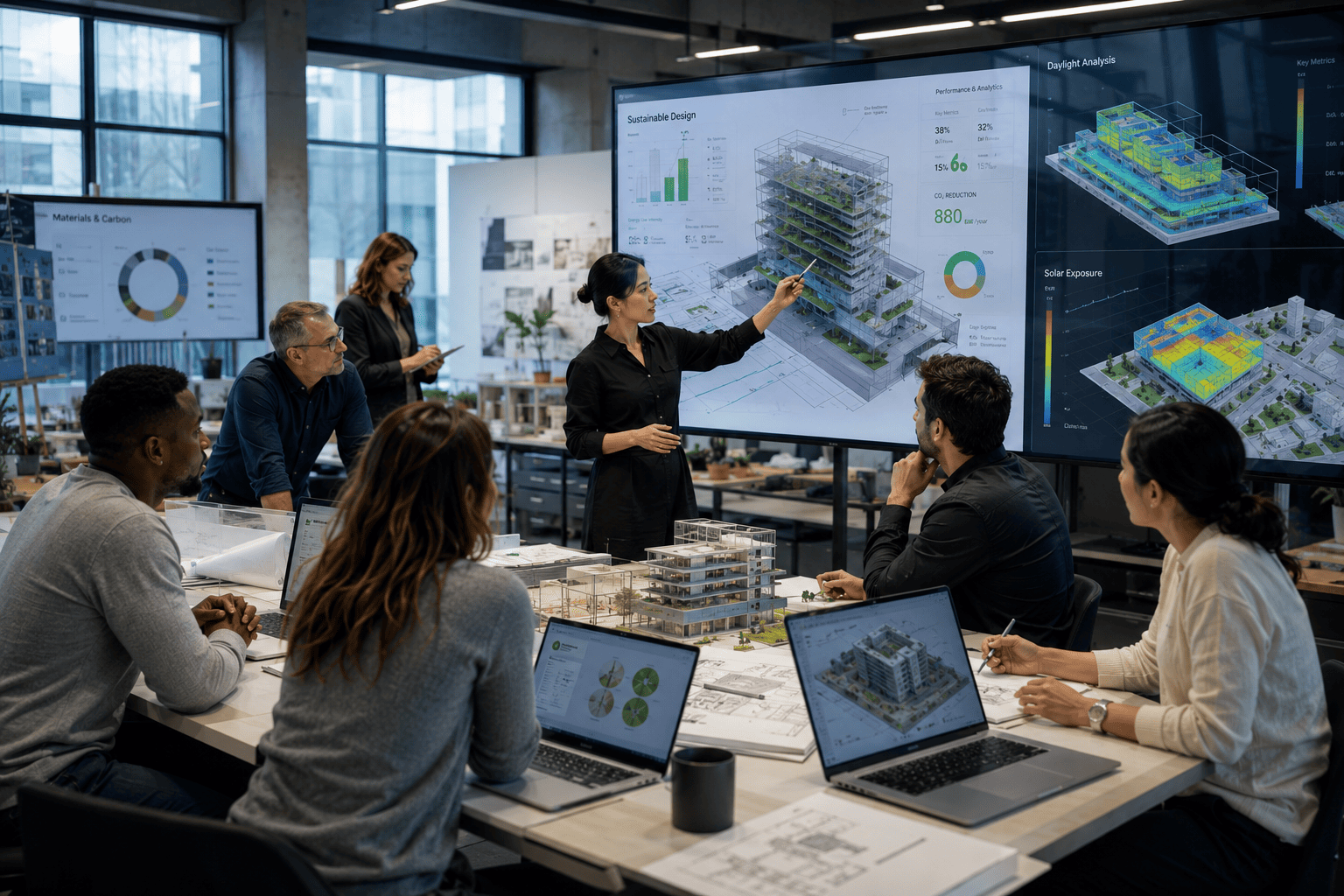
Sustainable BIM Intelligence

Energy Analysis & Performance-Driven Design using Revit & Forma

Design smarter and more sustainable buildings using data-driven BIM workflows. Learn how to analyze site conditions, optimize building orientation, improve daylight performance, and prepare energy-ready Revit models using industry-leading tools.

10 Hours | 5 Modules | 2 Hours per Session 

Download Brochure

The Sustainable BIM Intelligence program is designed for architects, BIM professionals, and design teams looking to integrate sustainability into the design process using Autodesk Revit and Autodesk Forma.

The training focuses on early-stage environmental analysis and performance-based decision making through practical workflows and real-world applications. 

Participants will learn how to evaluate site conditions and climate impact, perform solar and shadow analysis, optimize building orientation, develop performance-driven conceptual models, prepare Revit models for energy analysis workflows, and improve design efficiency using environmental insights.

What You Will Learn?

Sustainable BIM Workflows

Understand how sustainability can be integrated into BIM-based design processes from conceptual stages onward.

Site & Environmental Analysis

Learn to conduct solar studies, shadow analysis, orientation studies, environmental evaluations, and daylight-focused planning using Forma’s site intelligence tools.

Conceptual Design Optimization

Create conceptual building forms in Revit that respond to environmental conditions and support efficient building performance.

Energy Modeling Preparation

Prepare analytical-ready Revit models using zoning, envelope setup, and performance-based planning workflows.

Program Overview

Total Duration
Delivery Format
Mode
Approach
Software Covered (1)

Day 1: Foundations of Façade Design + Revit Tools

  • Importance of façade design (aesthetic, environmental & structural factors)
  • Revit UI walkthrough – façade-focused tools
  • Levels, grids, and reference planes
  • Intro to basic modelling: walls, floors
  • Curtain Wall Basics: system types, grid setup
    📂 Includes presentation slides and practice files

Day 2: Conceptual Massing & Façade Forms

  • In-place vs. conceptual massing
  • Creating and editing mass families
  • Surface division + placing pattern-based panels
  • Visualization: sun path, materials, shadows
  • Project Practice: Hungarian Autoklub HQ façade concept modelling

Day 3: Custom Curtain Walls – From Basic to Advanced

  • Advanced curtain wall grids, mullions & panels
  • Creating custom panels and mullion profiles
  • Nested families: operable panels, louvers, fins
  • Add smart parameters (height, width, material)
  • Apply it: Begin modelling custom façade for Hungarian Autoklub HQ

Day 4: Parametric Façade Design with Dynamo

  • Getting started with Dynamo
  • Creating parametric forms & dynamic panels
  • Extract geometry from Revit
  • Generate surface patterns like Voronoi, random grids 💡 Boost your computational design skills!

Day 5: Advanced Façade Techniques

  • Dive into Adaptive Components
  • Introduction to Kinetic Façades
  • Recreate famous kinetic façades:
    • KAFD Metro Station
    • Museo Soumaya
    • The Broad Museum
      🎥 Live modelling + walkthroughs

 Course Structure 

Module  Topics Covered  Duration 
Module 1  Sustainable BIM & Energy Analysis Fundamentals  2 Hours 
Module 2 Site Analysis Using Forma  2 Hours 
Module 3 Conceptual Design & Revit Integration  2 Hours 
Module 4 Energy Modeling Preparation in Revit  2 Hours 
Module 5 Design Optimization & Sustainable Strategies  2 Hours 


who shoul attend

Who Should Attend

This program is ideal for:

  • Architects 
  • BIM Architects 
  • Urban Designers 
  • Sustainability Consultants 
  • BIM Coordinators
  • Design Professionals
  • Architecture Students 

Learning Outcomes

By the end of this program, participants will be able to perform site and environmental analysis, create sustainable BIM workflows, develop performance-oriented conceptual designs, optimize building orientation and daylighting, prepare Revit models for energy analysis, and improve design decisions using environmental insights.

Course Trainers

Sample Headshot-1

Patrick Jones

JOB TITLE
Add a bio here...
Sample Headshot-1

Patrick Jones

Job Title
Add a bio here...

 Why Choose This Program? 

1
Icons Sustainable BIM Intelligence
3
4
5
6
ChatGPT Image May 28, 2026, 12_57_46 PM (1) (1)

Build Smarter. Analyze Earlier. Design Sustainably. 

Join the Sustainable BIM Intelligence program and transform the way you approach design performance and sustainable BIM workflows.

Register Now

Register here

Fields marked with an asterisk (*) are mandatory.